
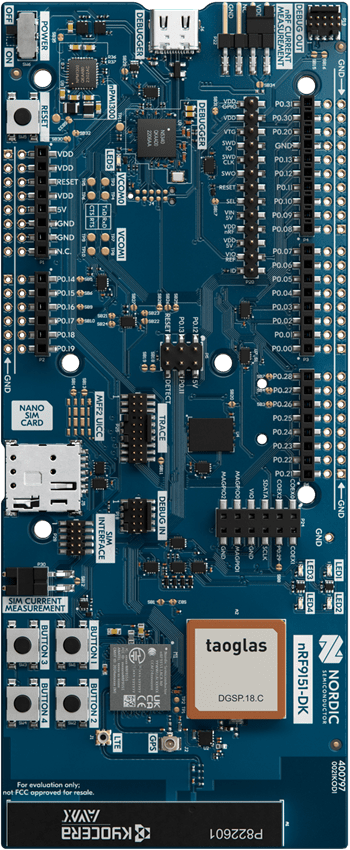
nRF9151 DK application and modem firmware
Selected version
nrf9151dk_mfw-2.0.4_sdk-3.2.1 [Latest Version]
Changelog:
nrf9151dk_mfw-2.0.4_sdk-3.2.1 [Latest Version] nrf9151dk_mfw-2.0.4_sdk-3.2.1.zip https://nsscprodmedia.blob.core.windows.net/prod/software-and-other-downloads/dev-kits/nrf9151-dk/application-firmware/nrf9151dk_mfw-2.0.4_sdk-3.2.1.zip sc_DownloadHWfiles_nRF9151DK
Changelog:
- Includes FW from nRF Connect SDK v3.2.1
- Includes Modem Firmware v2.0.4
The following samples and applications are part of the package:
- Serial Modem v1.0
- Asset Tracker Template v1.2.9
- Modem Shell
- AT Client
nrf9151dk_mfw-2.0.2_sdk-3.1.0 nrf9151dk_mfw-2.0.2_sdk-3.1.0.zip https://nsscprodmedia.blob.core.windows.net/prod/software-and-other-downloads/dev-kits/nrf9151-dk/application-firmware/nrf9151dk_mfw-2.0.2_sdk-3.1.0.zip sc_DownloadHWfiles_nRF9151DK
Changelog:
- Includes FW from nRF Connect SDK v3.1.0
- Includes Modem Firmware v2.0.2
The following samples and applications are part of the package:
- Serial LTE modem
- Asset Tracker Template
- nRF Cloud multi-service
- Enabled
overlay_coap.confandoverlay-coap_nrf_provisioning.conf
- Enabled
- Modem Shell
- AT Client
nrf9151dk_mfw-2.0.2_sdk-3.0.0 nrf9151dk_mfw-2.0.2_sdk-3.0.0.zip https://nsscprodmedia.blob.core.windows.net/prod/software-and-other-downloads/dev-kits/nrf9151-dk/application-firmware/nrf9151dk_mfw-2.0.2_sdk-3.0.0.zip sc_DownloadHWfiles_nRF9151DK
Changelog:
- Includes FW from nRF Connect SDK v3.0.0
- Includes Modem Firmware v2.0.2
The following samples and applications are part of the package:
- Serial LTE modem
- Asset Tracker Template
- nRF Cloud multi-service
- Enabled
overlay_coap.confandoverlay-coap_nrf_provisioning.conf
- Enabled
- Modem Shell
- AT Client
nrf9151dk_mfw-2.0.2_sdk-2.9.0 nrf9151dk_mfw-2.0.2_sdk-2.9.0.zip https://nsscprodmedia.blob.core.windows.net/prod/software-and-other-downloads/dev-kits/nrf9151-dk/application-firmware/nrf9151dk_mfw-2.0.2_sdk-2.9.0.zip sc_DownloadHWfiles_nRF9151DK
Changelog:
- Includes FW from nRF Connect SDK v2.9.0
- Includes Modem Firmware v2.0.2
The following samples and applications are part of the package:
- Serial LTE modem
- Asset Tracker v2
- nRF Cloud multi-service
- Enabled
overlay_coap.confandoverlay-coap_nrf_provisioning.conf
- Enabled
- Modem Shell
- AT Client
nrf9151dk_mfw-2.0.2_sdk-2.8.0 nrf9151dk_mfw-2.0.2_sdk-2.8.0.zip https://nsscprodmedia.blob.core.windows.net/prod/software-and-other-downloads/dev-kits/nrf9151-dk/application-firmware/nrf9151dk_mfw-2.0.2_sdk-2.8.0.zip sc_DownloadHWfiles_nRF9151DK
Changelog:
- Includes FW from nRF Connect SDK v2.8.0
- Includes Modem Firmware v2.0.2
The following samples and applications are part of the package:
- Serial LTE modem
- Asset Tracker v2
- nRF Cloud multi-service
- Enabled
overlay_coap.confandoverlay-coap_nrf_provisioning.conf
- Enabled
- Modem Shell
- AT Client
nrf9151dk_mfw-2.0.1_sdk-2.7.0 nrf9151dk_mfw_2.0.1_sdk-2.7.0.zip https://nsscprodmedia.blob.core.windows.net/prod/software-and-other-downloads/dev-kits/nrf9151-dk/application-firmware/nrf9151dk_mfw_2.0.1_sdk-2.7.0.zip sc_DownloadHWfiles_nRF9151DK
Changelog:
- Includes FW from nRF Connect SDK 2.7.0
- Includes Modem Firmware v2.0.1
The following samples and applications are part of the package:
- Serial LTE modem
- Asset Tracker v2
- nRF Cloud multi-service
- Enabled
overlay_coap.confandoverlay-coap_nrf_provisioning.conf
- Enabled
- Modem Shell
- AT Client
nrf9151dk_mfw-2.0.1_sdk-2.6.1 nrf9151dk_mfw-2.0.1_sdk-2.6.1.zip https://nsscprodmedia.blob.core.windows.net/prod/software-and-other-downloads/dev-kits/nrf9151-dk/application-firmware/nrf9151dk_mfw-2.0.1_sdk-2.6.1.zip sc_DownloadHWfiles_nRF9151DK
First release for nRF9151 DK
Changelog:
- Includes FW from nRF Connect SDK 2.6.1
- Includes Modem Firmware v2.0.1
The following samples and applications are part of the package:
- Serial LTE modem
- Asset Tracker v2
- nRF Cloud multi-service
- Enabled
overlay_coap.confandoverlay-coap_nrf_provisioning.conf
- Enabled
- Modem Shell
- AT Client
Hardware files
Selected version
1.0.0 Layout and BOM resources
Changelog:
1.0.0 Layout and BOM resources nRF9151 Development Kit - Hardware files 1_0_0.zip https://nsscprodmedia.blob.core.windows.net/prod/software-and-other-downloads/dev-kits/nrf9151-dk/hardware-files/nrf9151-development-kit---hardware-files-1_0_0.zip sc_DownloadHWfiles_nRF9151DK
- Improved PMIC layout to lower EMI
0.9.0 Layout and BOM resources nrf9151-development-kit--hardware-files-0_9_0.zip https://nsscprodmedia.blob.core.windows.net/prod/software-and-other-downloads/dev-kits/nrf9151-dk/hardware-files/nrf9151-development-kit--hardware-files-0_9_0.zip sc_DownloadHWfiles_nRF9151DK
- First release for nRF9151 DK (PCA10171)
nRF91x1 SiP DECT nr+ firmware
For access please contact Nordic sales or support
DECT NR+ Firmware Binaries

The official DECT NR+ firmware binaries can be accessed by contacting Nordic Sales, check the changelogs for more information what the different version has introduced.
-
Changelog: MAC and PHY v2.0.0
-
This release introduces comprehensive DECT MAC (Medium Access Control) layer functionality, building upon the existing PHY layer capabilities.
This release supports star network topology.This release supports: nRF9151 LACA A0/A1 SiP
This firmware supports the "Release 2 of the DECT-2020 New Radio (NR) technical specification v2.1.1"
DECT NR+ operation is enabled on frequency bands 1, 2, 3, 4*, 9 and 22. (*only on the nRF9151).
Highlights:
The MAC layer provides high-level network management, device association, and data communication services for DECT-2020 NR applications.
- Network Management: Full star network topology support with network/cluster management, discovery, and RSSI scanning.
- Device Communication: Association management with up to 6 concurrent flows, using RACH (uplink) and paging (downlink).
- Data Link Control (DLC): Four service modes (Transparent, Segmentation, ARQ) with advanced flow control.
- Advanced MAC Features: Link adaptation (MCS & power), HARQ, MAC-level security (Mode 1), IPv6 support, and configurable power saving (PT mode).
- Operational Modes: Supports Fixed Termination (FT) parent and Portable Termination (PT) child roles.
- Clock Synchronization: Clock synchronization to external 1PPS input and 1PPS output generation.
A complete list of new functionality, changes and bug fixes is in the release notes found here or inside the .zip file.
This release is aligned with v1.3 of the nRF91x1 DECT NR+ AT Commands Reference Guide.
It is advisable to use the latest version of nRF Connect for Desktop and nRF Connect Programmer tools.
Some features require support from the nRF Connect SDK, and it is recommended to ensure compatibility with the appropriate version of the SDK.
Customers are encouraged to use NCS/main. The nRF Connect SDK release v3.3.x. will support the API fully.
-
-
Changelog: PHY only v2.0.0
-
This release includes PHY layer only.
This release supports: nRF9151 LACA A0/A1 SiPThis firmware supports the "Release 2 of the DECT-2020 New Radio (NR) technical specification v2.1.1"
DECT NR+ operation is enabled on frequency bands 1, 2, 3, 4*, 9 and 22. (*only on the nRF9151).
Highlights:
- L1 Control: Refactored for improved maintainability.
- Clock Synchronization: Added support for external 1PPS input and 1PPS output generation.
- General Improvements: Includes various bug fixes and removal of unnecessary AT commands.
A complete list of new functionality, changes and bug fixes is in the release notes found here or inside the .zip file.
This release is aligned with v1.3 of the nRF91x1 DECT NR+ AT Commands Reference Guide.
It is advisable to use the latest version of nRF Connect for Desktop and nRF Connect Programmer tools.
Some features require support from the nRF Connect SDK, and it is recommended to ensure compatibility with the appropriate version of the SDK.
Customers are encouraged to use NCS/main. The nRF Connect SDK release v3.3.x. will support the API fully.
-
-
Changelog: PHY only v1.1.0
- • Enabling a 1-slot turnaround time for PHY operations in low-latency modes
- • Added support for adding and removing scheduled operations
- • Enhanced support for various radio modes to improve power consumption across different use cases.
- • Added reporting of turnaround times for different radio modes.
- • Introduced support for DECT NR+ band 4, available on the nRF9151 LACA A0 and nRF9151 LACA A1.
- • Add support for 21 dBm output power on bands B1, B2, B9, and B22, available on the nRF9151 LACA A0 and A1.
Note: Output power on Band 4 is limited to 19 dBm. - • Included battery voltage values in PHY operation callbacks.
- • Added operation handle values for all PCC and PDC reception callbacks, simplifying packet identification for RX operations.